One installation. Endless aerial possibilities.
Designed for Professional Studios
The system is modular and scalable, making it suitable for small studios and large training or performance venues. It is available with 1 to 8 rigging points, allowing you to build a fully adaptable aerial setup.
Each rigging point includes carefully engineered components designed for durability, safety, and smooth operation.
Smart, Efficient, and Flexible
The Lupit Aerial Pulley System makes aerial rigging significantly more efficient. Instead of complex installations or heavy lifting, instructors can easily raise or lower equipment and switch apparatuses in minutes.
To determine the total quantity of components needed, simply multiply the rigging point components by the number of desired rigging points.
For proper installation, the correct rope length for each rigging point must be calculated based on ceiling height and the direct distance from the upper wall bracket.
-
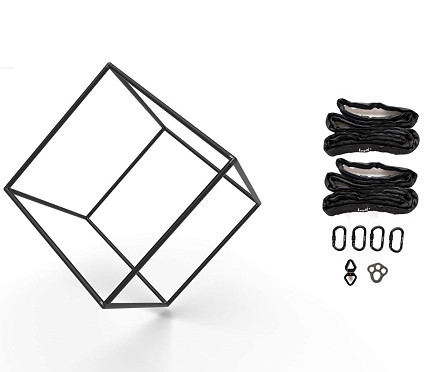
1 Aerial Ceiling Mount – heavy-duty interface for secure and optimal load distribution
-
3 Lupit Single-Wheel Pulleys – precision pulleys with minimal friction for smooth rope movement
-
3 Steel Carabiners – load-rated connectors ensuring maximum strength
-
1 Aluminium Carabiners – lightweight connectors for easy maneuverability
-
10 mm Static Rope – certified low-stretch rope for strength and control (10m/32ft 9.7in or 20m/ 65ft 7.4in)
-
2 Wall/Ceiling Brackets – secure anchor points designed for maximum stability and safety
(These remain two per system, regardless of the number of rigging points.) -
1 Sand bag
A Long-Term Investment for Serious Studios
This system was created with one clear vision: to give aerial studios a permanent, professional solution for flexible rigging.
The Lupit Aerial Pulley System is not just another piece of equipment—it is a long-term investment in your studio’s growth, safety, and creativity.
With a single installation, you gain the ability to transform your studio again and again:
-
from training space to performance stage,
-
from silks class to flying pole workshop,
-
from aerial conditioning to artistic exploration.
For studio owners who take aerial arts seriously, this system becomes the invisible backbone that supports everything happening above the ground.
| No. of mounts | Rope length 32'9.7"/10m | Rope length 65'7.4"/20m |
| 1 | 482,91 € | 498,91 € |
| 2 | 883,82 € | 915,82 € |
| 3 | 1.284,73 € | 1.332,73 € |
| 4 | 1.685,64 € | 1.749,64 € |
| 5 | 2.086,55 € | 2.166,55 € |
| 6 | 2.487,46 € | 2.583,46 € |
| 7 | 2.888,37 € | 3.000,37 € |
| 8 | 3.289,28 € | 3.417,28 € |
| No. of mounts | Rope length 32'9.7"/10m | Rope length 65'7.4"/20m |
| 1 | 627,78 USD | 648,58 USD |
| 2 | 1.148,97 USD | 1.190,57 USD |
| 3 | 1.670,15 USD | 1.732,55 USD |
| 4 | 2.191,33 USD | 2.274,53 USD |
| 5 | 2.712,52 USD | 2.816,52 USD |
| 6 | 3.233,70 USD | 3.358,50 USD |
| 7 | 3.754,88 USD | 3.900,48 USD |
| 8 | 4.276,06 USD | 4.442,46 USD |
LUPIT AERIAL PULLEY SYSTEM – Installation instructions
1. Planning Before Ordering
Proper planning is essential to ensure a safe and functional installation.
Studio Assessment
• Prepare a floor plan with accurate ceiling height and room dimensions.
• Verify wall and ceiling construction (material, load-bearing capacity).
• Submit the floor plan with measurements to Lupit for calculation of:
o Number and positions of ceiling mounts (rigging points)
Positioning Guidelines
• Minimum distance between ceiling mounts: 2.2 m
• Minimum distance from walls/obstacles: 1.6 – 2.0 m
Wall Brackets
• Determine suitable locations for wall brackets:
o Ideally positioned centrally on the longest wall
o Confirm structural integrity of the wall
Measurements for Rope Calculation
• Measure the distance between each ceiling mount and upper wall bracket
• Submit all measurements to Lupit to determine custom rope lengths per rigging
point
Quotation
• Request a quotation for your Lupit Aerial Pulley System configuration
------------------------------
2. Installation
⚠ All fixations must be installed into structurally adequate, load-bearing elements using
certified anchoring solutions.
Step 1 – Marking
• Mark all positions for aerial ceiling mounts, upper and lower wall brackets
Step 2 – Ceiling Mount Installation
• Install and secure ceiling mounts using appropriate anchors for the specific
ceiling material
Step 3 – Wall Bracket Installation
• Install the upper wall bracket:
o Orientation: rings and pulleys facing downward
o Position: 100–300 mm below the ceiling
• Install the lower wall bracket:
o Orientation: rings facing upward
Step 4 – Rope and Pulley Installation
• Verify the rope length for each rigging point
• Follow the installation drawing provided by Lupit
• Install each rope individually and systematically:
o Ensure ropes do not cross or overlap
o Work consistently from one side of the system
Rope Routing Procedure
1. Lead the rope through Pulley No. 1
2. Attach the rope’s end loop to the ceiling mount using a steel carabiner
3. Attach Pulley No. 2 to the same ceiling mount using a steel carabiner
4. Route the opposite rope end through Pulley No. 2, then continue toward the
upper wall bracket
5. Guide the rope through Pulley No. 3 on the upper bracket (top-down direction)
6. Lead the rope downward toward the lower bracket
7. Secure the rope’s end loop to the designated ring on the lower bracket using a
steel carabiner
---------------------------
3. Use and Operation
Connecting the Apparatus
• Attach the aerial apparatus to Pulley No. 1 using:
o Carabiner – swivel – carabiner configuration
o This prevents rope twisting and improves system longevity
Adjusting Height
• Pull the designated rope to reach the desired height
• Create a secure knot loop at the appropriate position
• Attach the loop to the designated holding ring
Safety Check (Before Every Use)
• Inspect:
o Rope condition
o Carabiners and connections
o Anchoring points
o Pulley movement
• Ensure all components are properly secured before use
----------------------------
4. Responsibility and Safety Notice
⚠ The installer and user are fully responsible for:
• Correct installation
• Proper anchoring
• Suitability of structural elements (walls/ceiling)
Lupit cannot supervise individual installations and therefore assumes no responsibility for improper installation or misuse.